
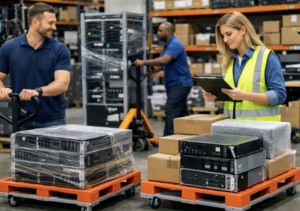
In an IT company, hardware logistics is rarely treated as a headline issue until something goes wrong. Servers arrive damaged. Networking equipment gets delayed between locations. Replacement parts are stacked poorly in storage. Field technicians lose time hunting for organized inventory. A warehouse that looked functional on paper starts creating hidden inefficiencies that affect project timelines, client service, and profitability. That is why pallet choice matters more than many technology leaders realize.
Whether an IT company handles laptops, monitors, switches, routers, rack components, peripherals, or infrastructure equipment for data center and office deployments, the way those assets are stored and moved has a direct impact on operations. Reliable Mid-Duty Pallets provide a smart balance between strength, flexibility, and cost control for hardware logistics. They support organized storage, consistent material handling, safer transport, and a cleaner inventory environment without pushing a company into unnecessary overengineering.
As IT companies continue expanding their device fleets, refreshing infrastructure, and supporting distributed operations, logistics has become a business issue rather than just a warehouse issue. The broader technology market is also putting more pressure on physical hardware movement. Demand tied to AI infrastructure, data center growth, and hardware investment continues to shape supply chains across the industry, making dependable internal logistics more important than ever, as seen in recent reporting from Reuters, The Wall Street Journal, and AP News.
The Real Logistics Demands Behind Modern IT Operations
An IT company may not think of itself as a warehouse-driven business, but many of its daily responsibilities depend on organized physical inventory. Managed service providers keep replacement devices and networking equipment ready for client emergencies. IT integrators coordinate incoming and outgoing shipments for installations. Data center support teams manage racks, parts, cable assemblies, and hardware staging. Internal enterprise IT departments handle constant movement of monitors, docking stations, desktops, printers, access points, and decommissioned equipment.
That hardware must be protected, counted, moved, staged, and retrieved efficiently. A pallet, by definition, is a transport structure designed to support goods while they are lifted and moved by equipment such as forklifts and pallet jacks, as explained by Wikipedia. In practice, for an IT company, the right pallet becomes part of a larger system of inventory control and workflow consistency.
When pallet quality is poor or pallet capacity does not match the actual load profile, the result is often subtle but expensive. Boxes shift. Packaging weakens. Storage footprints become inconsistent. Teams create workarounds. Safety risks rise. The company starts absorbing small losses in time and product condition that add up over months of operation.
Why Mid-Duty Pallets Make Sense for IT Hardware
Not every hardware load requires an extremely heavy industrial pallet, and not every IT environment can get by with lightweight handling platforms. That is where mid-duty solutions stand out. They are well suited for loads that need dependable support without unnecessary bulk, making them ideal for many technology companies handling boxed devices, hardware components, equipment accessories, and mixed inventory.
An IT company often stores a broad range of products with varying dimensions and weights. Some loads are compact and dense, like batteries, peripherals, and small networking components. Others are larger but lighter, such as monitors, keyboards, or packaged workstations. Mid-duty pallets create a practical middle ground for these mixed-use conditions. They support repeat movement through storage and shipping areas while helping operations stay efficient and organized.
This matters even more in a market where hardware conditions can shift rapidly. IDC recently reported continued pressure on device markets from memory shortages and pricing changes, underscoring how hardware planning and inventory discipline remain important across the technology sector, according to IDC. When products are more expensive, harder to source, or more critical to project delivery, protecting them inside the warehouse becomes a stronger operational priority.
Better Protection for High-Value Equipment
IT hardware is valuable, but it is also vulnerable. Even when products arrive in manufacturer packaging, they are still exposed to stacking pressure, impact during movement, compression in storage, and instability during transport inside a facility. A pallet that performs reliably helps reduce those risks by creating a stable base for the entire load.
For an IT company, that stability matters because the products involved are often tied directly to revenue-generating work. A damaged server component can delay deployment. A crushed shipment of laptops can derail an onboarding schedule. A mishandled networking order can slow a client project and create avoidable service issues. Reliable pallet support helps reduce the chance that physical handling problems become client-facing problems.
The technology world is investing heavily in physical infrastructure, not just software and cloud services. Reuters recently reported continued momentum around major AI and hardware investments, reflecting how much the sector depends on the real-world movement of equipment and components across supply chains and facilities Reuters. For companies that manage hardware directly, dependable pallet systems are part of protecting that investment at the ground level.
Improved Warehouse Organization and Faster Access
A reliable pallet strategy helps an IT company create order in spaces that can otherwise become cluttered fast. Hardware logistics usually involve multiple categories moving at once: new devices, refurbished equipment, returns, accessories, spare parts, cabling, warranty replacements, and staged job materials. Without consistent palletized storage, these categories can blur together and cause confusion.
Mid-duty pallets make it easier to standardize how products are stored, labeled, and accessed. That improves bin logic, staging practices, and floor layout planning. Teams can build clearer storage zones for incoming inventory, outbound orders, high-priority replacement stock, and retired equipment awaiting processing. That structure saves labor, reduces mispicks, and helps technicians and warehouse staff find what they need without delay.
In a growing technology environment, speed matters. If a field team needs a replacement firewall, switch, or laptop right away, the company cannot afford to waste time navigating disorganized stacks of mixed inventory. Better pallet-supported organization shortens retrieval times and strengthens operational confidence.
Safer Material Handling for Employees and Equipment
Safety is one of the most overlooked reasons to invest in better pallet solutions. Unstable or damaged pallets can lead to poor load balance, collapsing stacks, difficult jack movement, and awkward manual repositioning. In an IT logistics environment, that creates unnecessary risk for employees and for the expensive hardware being handled.
Reliable mid-duty pallets help maintain predictable handling conditions. They support cleaner movement through aisles, docks, and staging zones. They also reduce the temptation to improvise with unsuitable platforms or overloaded storage methods. A safer warehouse is not only better for employees. It is also better for service consistency, insurance exposure, and overall operating discipline.
That matters in a logistics landscape becoming more specialized around technology infrastructure. The Wall Street Journal recently reported that logistics providers are expanding warehouse capacity to support data center and component supply needs, highlighting the increasing complexity of tech-related hardware movement The Wall Street Journal. Even smaller IT companies can learn from that trend by tightening their own material handling standards before growth makes the need more urgent.
A Smarter Fit for Mixed Hardware Inventories
One reason mid-duty pallets are especially useful for IT companies is that technology inventory is rarely uniform. An operation may handle compact spare parts one day and bulk workstation shipments the next. It may stage equipment for one large deployment while also maintaining service stock for recurring client support. That kind of variety calls for pallet solutions that are dependable but adaptable.
Heavy-duty pallets can be more than necessary for many IT applications, especially when floor space, maneuverability, and cost efficiency matter. Lightweight options, on the other hand, may not give enough consistent support for repeated use and mixed loads. Mid-duty pallets often fit the real operational profile better by balancing durability with practicality.
That balance becomes even more important as the technology sector grows more infrastructure-intensive. Broader concerns around data center expansion and power demand show how fast physical tech operations are evolving, as covered by AP News. The more hardware an organization handles, the more valuable dependable storage and transport systems become.
Operational Efficiency That Supports Client Service
Clients usually never see the warehouse side of an IT company, but they absolutely feel its impact. If inventory is well managed, deployments happen faster. If replacement stock is protected and easy to access, downtime gets resolved sooner. If outbound shipments are prepared accurately, project execution looks smoother and more reliable.
That is why pallet quality should not be treated as a background purchasing decision. It affects response times, asset control, labor efficiency, and damage prevention. When an IT company invests in more dependable hardware logistics, it is also investing in better client experience.
This is especially relevant in a market where physical infrastructure spending continues to accelerate. As major technology players keep building around AI, compute, and hardware capacity, the broader supply chain environment remains active and competitive, as recent Reuters coverage has shown Reuters. Companies that rely on hardware cannot afford casual warehouse habits when the assets moving through their facilities are increasingly valuable.
Reliable Pallets Help Build a More Scalable IT Operation
What works for a small storage room often fails once an IT company starts growing. More clients, more devices, more deployment projects, and more replacement inventory all place pressure on the warehouse system. A company that prepares early with stronger pallet-supported organization has an easier path to scale.
Reliable mid-duty pallets help support that transition. They make it easier to expand storage areas logically, create repeatable handling procedures, and keep hardware flow under control as volume increases. Instead of rebuilding warehouse habits later under pressure, a company can establish a better foundation now.
Scalability in IT is often discussed in terms of cloud capacity, automation, and staffing. Those things matter, but physical logistics still plays a major role for any company moving real devices and infrastructure. Better pallets support the practical side of growth in a way that is easy to underestimate until demand exposes the weakness.
Conclusion
An IT company depends on more than technical skill and software knowledge to serve clients well. It also depends on how effectively it manages the physical flow of hardware behind the scenes. Reliable mid-duty pallets support safer handling, stronger organization, better equipment protection, and more efficient operations across storage, staging, and transport.
For companies managing laptops, servers, networking gear, monitors, accessories, and replacement inventory, the right pallet choice is not a minor warehouse detail. It is part of building a more disciplined, responsive, and scalable business. In a technology environment shaped by rising infrastructure demand, tight hardware conditions, and increasing logistics complexity, dependable pallet systems can give an IT company a meaningful operational advantage.